What a cord really is, which wood burns hottest, how to get more heat from your stove, and how to stay safe with fire and trees.
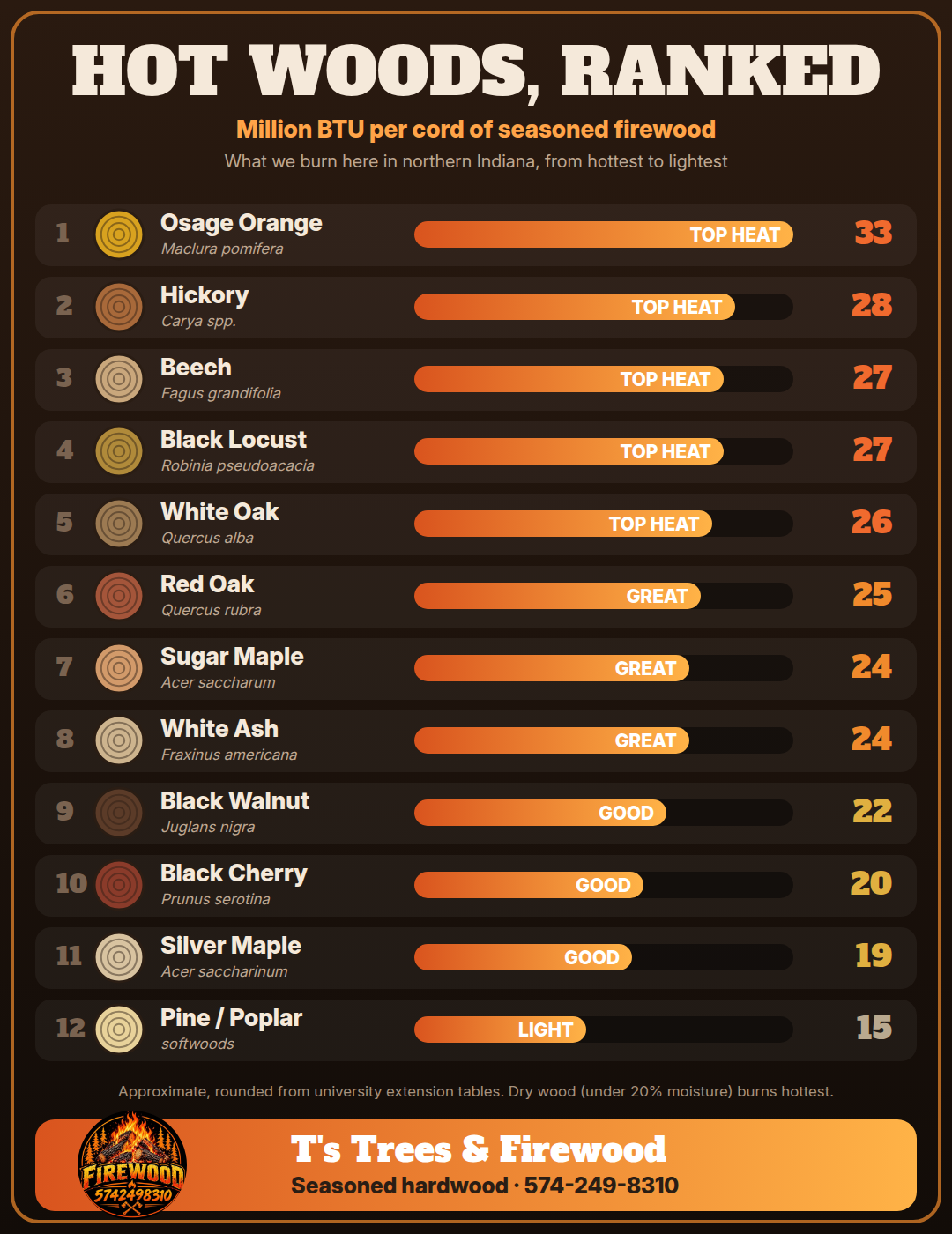
Download the chart (PNG) to print or share. Dense hardwoods give the most heat per cord. See the full list in Which wood burns best?
A full cord is a stack 4 feet high, 4 feet wide and 8 feet long: 128 cubic feet of stacked wood, air gaps included. It's the only legal, standard unit of firewood.
A face cord (also called a rick or a stove cord) is a stack 8 feet long and 4 feet high, but only one split log deep instead of 4 feet. How deep depends on how long the logs are cut. With the usual 16 inch logs it is one third of a full cord, which is how we count: three face cords make a full cord.
Because "a truckload" or "a rick" can mean almost anything. Ask for the stack size in feet (length x height x log length) and compare on a cord basis. If a seller won't tell you the dimensions, that tells you something.
It depends on the house and the stove. A home that heats mainly with wood in northern Indiana may go through several full cords. A fireplace used on weekends may use half a cord or less. Start with what you burned last year, and buy a little more than you think.
About 4 x 8 feet of floor space for a full cord stacked 4 feet high. A face cord is only about 8 feet of wall length. We can stack it for you where you want it.
Seasoned means the wood has dried down to about 20% moisture or less. Fresh-cut (green) wood can be 40 to 50% water. Burning that water off takes heat away from your house instead of putting it in.
Look for cracks at the ends, grey or darker colour, and bark that peels away. Two pieces knocked together should ring with a clear "clack", not a dull thud. Dry wood feels light for its size. A $20 moisture meter is the surest check: split a piece and test the fresh face.
Split and stacked off the ground with the top covered: roughly 6 to 12 months for ash, maple and cherry, and 12 to 24 months for oak and hickory. Splitting is the key. Whole rounds hardly dry at all.
The fire has to boil off the water before the wood can burn well. That makes a cooler, smokier fire, and the smoke carries more creosote up your chimney. Seasoned wood burns hotter and cleaner.
Keep it off the ground on pallets or rails, stacked so air can move through it, with the top covered and the sides open. Keep it a few feet from the house, since stacks against the wall can bring in bugs and mice.
Dense hardwoods: Osage orange, hickory, beech, black locust and oak give the most heat per cord and burn the longest. Maple and ash are close behind and are easier to light. See the ranking chart above.
Not bad, just fast. Pine and other softwoods light easily and burn hot and quick, so they're good for kindling and mild fall days. They don't last the night, and they leave more soot in the chimney, so keep them to a small share of what you burn.
Heat content varies with the tree, where it grew and how dry the wood is, and sources round differently. Treat the chart as a guide to the pecking order, not a lab report.
Burn seasoned wood, give the fire enough air, and don't choke it down too early. A smouldering, starved fire wastes most of the wood as smoke and creosote. A hot, bright fire burns the smoke too, so more of the wood turns into heat.
Try it. Put the biggest splits on the bottom, then smaller splits, then kindling on top, and light the top. It burns cleaner and steadier and lights fast with less smoke. Many stove makers recommend it.
Most stoves like splits about 3 to 6 inches across, with a few bigger ones for a long overnight burn. Splits that are too big burn slowly and smoulder. Too small, and they burn out fast.
Put a stove thermometer on the flue or stovetop so you can see the sweet spot. Add new wood onto a bed of hot coals, not a dead fire. Open the air control for 10 to 15 minutes after you reload. Burn a mix of woods, with the dense ones for night. And keep your chimney and the stove's door gasket in good shape.
Have it inspected every year, before burning season, and swept when needed. Fire safety groups say to sweep when soot or creosote builds up to about an eighth of an inch. If you burn a lot, you may need it more than once a year. Pick a CSIA-certified chimney sweep. We sell and stack firewood and remove trees. We don't sweep chimneys.
Creosote is the sticky, tarry film left by smoke as it cools in the flue. It burns hot and is the cause of most chimney fires. Cool, smoky fires (green wood, a choked-down air supply) make the most of it.
A working smoke alarm on every floor and a carbon monoxide alarm near the bedrooms. Test them when the clocks change. Keep a fire extinguisher where you can reach it, and keep anything that burns at least 3 feet from the stove or fireplace.
Ashes hide hot coals for days. Scoop them into a metal bucket with a metal lid, set it outside on a non-flammable surface like concrete, away from the house, deck and woodpile, and leave it for several days before you dump it.
Painted, stained or pressure-treated wood, plywood and particleboard, trash, cardboard, and Christmas trees. They give off harmful fumes or burn too fast and hot. Never use gasoline or other liquid fire starters in a stove or fireplace.
Get everyone out of the house and call 911. Loud roaring or cracking, thick smoke or flames from the top of the chimney are the signs. Don't use the chimney again until a sweep has inspected it.
Tree work injures and kills people every year. A falling tree, a kicked-back chainsaw, or a limb under tension can do serious harm in a second. A crew has the training, the gear and the rope and rigging to bring a tree down where you want it, not on your house.
Stay away. Treat every line as live, keep yourself, ladders and tools at least 10 feet away, and call your utility. Don't try to cut anything that touches or leans on a line.
Take down big trees in tight spots, remove storm-damaged limbs that are hung up or under tension, cut safely over a roof or fence, and haul away the brush so you don't get left with a mess. We can also turn the tree into firewood.
Get a written estimate that says what's included, such as cleanup and haul-away, and ask who will be on your property. Be careful with anyone who knocks on your door after a storm asking for cash up front.
Keep people and pets inside and well back from the work, at least twice the height of the tree. Move cars out of the area. Don't stand under a tree or limb that is being cut.
Dead or leaning trees, big cracks, large dead branches over the house, fungus at the base, or any tree hit by a storm. A free estimate costs nothing. Call or text Ty at 574-249-8310.
More: Firewood prices · Tree removal · Delivery and stacking · Quick FAQ · back to T's Trees & Firewood home